
10 effective remedies for blisters (prevention, care, and treatment)
10 effective remedies for blisters (prevention, care, and treatment)
We must not forget that the skin is not just another organ of the body but, in fact, with more than two square meters of extension, it is the largest organ. Acting as our main protective barrier against external threats, the skin is essential for the elimination of pathogens and other physical and chemical dangers within our interior.=
But this is not simple armor. We are dealing with a living tissue where different types of cells allow it not only to carry out its physiological functions but also to protect itself. The skin, through close contact with the immune system, protects itself when damaged. The skin is alive. And he protects himself.
And it is precisely in this context that, in the face of burns, chafing, abrasions or dermatological diseases, such famous, odious and annoying blisters can appear, bags full of fluids that are found in the outermost layer of the skin, generally on the hands and feet, in response to injuries of the same.
So, in today’s article and from our collaborative team of dermatologists and leading scientific publications, we’ll understand exactly what blisters are, why they appear, and most of all, how to treat and cure them . Let us begin.
What are blisters and why do they appear?
A blister is a fluid-filled sac that forms on the outermost layer of skin, usually in the hands and feet, although it can develop in any part of the body in response to an injury to it. They are usually seen due to burns, scratches, abrasions, excessive frequency of sun exposure, dermatological diseases, etc.
On a more technical level, blisters are a defense mechanism of the body that consists of an inflammatory, visible, and insecticidal lesion formed by blisters filled with lymphatic fluid along with other body fluids. This lymph is a colorless fluid rich in white blood cells, so it is essential as part of the immune response.
This lymphatic fluid, to protect the internal integumentary tissue, is concentrated in the epidermis, the outermost (and thinnest) layer of the skin, with an average thickness of 0.1 millimeters, creating the typical bubble filled with this lymph. This entire blistering process is aimed at repairing skin damage.
Damage is usually due to mechanical irritation (usually rubbing from shoes), frostbite, abrasions, sunburn, friction, eczema, allergic reactions, contact with poisonous plants, viral infections (such as rashes), impetigo, burning, epidermolysis bullosa, autoimmune disorders, dermatitis atopic, exposure to irritating chemical products, etc.
Anyway, as we can guess from what we have seen, blisters are not bad . In fact, they are a mechanism of the skin itself to repair its damage, which it achieves by forming this bubble filled with lymphatic fluid to prevent infections. Therefore, the blisters should not be removed. They heal themselves. All we have to do (and see how) is apply remedies to keep the blister clean and speed up recovery.
How should a blister be treated and healed?
As they say, prevention is better than cure. Therefore, next, in addition to seeing how to treat blisters correctly, we will see ways to prevent them from appearing. So, let’s see the best tips to prevent blisters from appearing and cure them if they appear only in a healthy way for the skin.
1. Put on comfortable shoes.
As we have said, most blisters appear on the hands and feet. And for the feet, the most common cause is the result of wearing shoes that rub against the skin. Therefore, the first tip to prevent one of the main causes is to wear shoes that fit well. Also, it is important to try different socks and inserts that are specifically designed to prevent blisters. Not to mention that it is essential that the socks protect the entire contact area of the shoe with the skin .
2. If you work with your hands, wear gloves.
The hands are the second main area of blister formation, especially due to friction, rubbing, or burning in trades where many mechanical functions of these hands are required. Therefore, it is important that you work with gloves if you think you may be experiencing friction. They will protect you and are less likely to cause blisters.
3. Shield yourself against solar radiation
Sunburn is one of the main causes of blisters, so one of the most important ways to prevent them is to protect ourselves from solar radiation. However, it should be noted that sunburn blisters are often linked to severe burns, so when they do occur, it is best to see a doctor as specific treatment is likely to be required.
Do not scratch the blister.
There are times when, due to discomfort or itching, we feel like scratching the blister. This is something that should never be done, since not only do we damage the skin and the wound takes longer to heal, but there is also the risk that a blister becomes infected and, when we heal, a scar remains. Therefore, we must avoid scratching ourselves. And if (generally the blisters are linked to dermatological diseases) it is impossible not to do it, we should go to the dermatologist.
Do not burst the blister.
It’s very tempting to pop that liquid-filled bubble that’s bothering us so much anyway. But this is one of the biggest mistakes we can make. Not only is it, as we said, the lymphatic fluid inside the blister protecting the wound and accelerating the recovery of the skin, but the risk of infection increases a lot, since that closed bubble becomes an open wound.
Also, when a blister breaks aggressively, the fluid leaks out and dries on the skin, creating a yellow crust. And if this open wound doesn’t heal properly, even if the tear was accidental, it’s more likely to lead to infection. Therefore, a blister should never burst. Drainage may not be considered if it is particularly large and painful. But we’ll talk about it at the last point, because it really is the last resort.
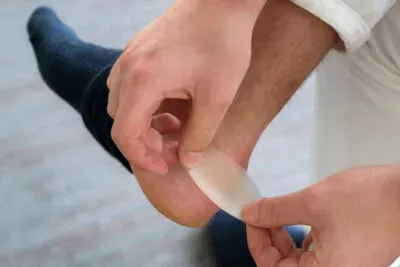
Cover the blister with an adhesive bandage.
Protecting the blister, accelerating its recovery, reducing the risk of infection, and avoiding its rupture (of the consequences that we have analyzed in the previous point) is of the utmost importance, especially if it is in the area where it is located. To prevent friction, we cover this blister with a bandage or adhesive bandage. You can easily find them in any pharmacy and they are highly recommended to cure and treat blisters.
7. Examine for signs of infection.
As we have already intuited throughout the article, the only danger of a blister, beyond its visual impact and discomfort, is that it becomes infected . The infection that can arise if the advice we have seen is not followed is complicated, although there are times, even when applied, the blister can become infected.
In the case of infection, we will have to go to the doctor to clinically address this case and thus reduce the risk not only of scars but of more serious health problems. Therefore, if you notice pus (the fluid should be colorless because it’s lymphatic fluid, but if there’s an infection, look for pus, which is whitish in color), excessive swelling, redness, pain that gets worse with time, and, of course, fever, a visit to the doctor is mandatory.
8. Use soap and water to clean the vial.
To heal the blister and prevent infection, it is essential to keep it clean . We need to wash the area daily with warm soapy water to clean it and reduce the risk of infection. Of course, we have to leave it smooth, otherwise we can break it or damage the skin. We can also clean the blister with an iodinated swab. In any case, the area of the bubble is very clean so that its recovery is faster and, in the event of accidental breakage, the risk of infection is lower.
9. Include ointments
After washing the blister, another highly recommended practice is to apply ointments to it. It contains creams (including petroleum jelly) that accelerate wound healing, mechanically protect the blister, and reduce the risk of infection. You can get one of these ointments at your trusted pharmacy. But yes, it must be taken into account that if a rash appears on the skin after application, its application should be suspended.
10. Go to the doctor to have the blister drained.
last tip, as it should be the last resort. Blister drainage by a doctor is considered only in cases of infection, exaggerated pain, abnormal size (more than 2 centimeters), blisters associated with severe burns, etc. That is, a blister should only be drained in very rare cases and should always be done by a doctor. Unless we have clinical knowledge and access to disinfectant material, we should never do it.
But in severe cases, we must go to a doctor. And in a hospital environment, the lymphatic fluid (or pus, if there is an infection) will be drained through sterile needle punctures and other procedures to speed recovery. But in the vast majority of cases, this drainage is not necessary. Blisters should not be removed because they are a defense mechanism. With the care we have seen, they disappear by themselves a few days after their appearance.
Read Also :
The 5 types of folliculitis (causes and treatments)